Saturday, January 30, 2016

Ironman Arizona Race Report - Chapter 1: Don't Drown

I could write an incredibly awesome blog about how I got to Ironman Arizona (aka – the Epic Road Trip with my Dad) – but for now, I know people really want to read about my race experience…so I might fill in details about the trip in a follow-up series of blogs (likely sometime in the next millennium).

In other words….just pretend you know everything that happened on my journey prior to race day. Like skipping over the beginning of the book or movie and going straight to the climactic scene. Not that I’d ever recommend doing that!
 

Bike ramp leading into Tempe Beach Park

The calm before the storm

My hotel (Hampton Inn on Scottsdale Road) arranged to have breakfast available from 4:30am for everyone on race day. I decided that rather than worry about getting to the race site right when transition opened, I’d just eat my normal breakfast and then get there when I got there. Having dropped my bags and bike off the day before, there really wasn’t much for me to do to ‘prepare’ on race day other than to check my tires and make sure my Speedfil was full. I didn’t want to be wandering around in the cold for 2 hours before the race start.

So I got up around 4:30am, rolled out of bed and went downstairs with my Dad to get breakfast. Needless to say, I stuck to my standard race day fare: A bagel with peanut butter,  and a coffee (Nothing new on race day!). To be honest, it was nice to have some time to sip my coffee, eat and watch other people getting ready for the long day ahead. It was the calm before the storm if you will.

Not that I was particularly calm. I am pretty sure my hands were shaking as I slathered peanut better on my bagel – but I was excited and confident about the day to come.

When we got outside, it was chilly (Around 50F/10C) but dry. Thankfully, I knew how cold it was going to be from watching three friends race last year, so I was dressed well in warm-up pants, long sleeved shirt and jacket. We drove to the race site and managed to get a great parking spot just across from Tempe Beach Park. Thanks to my dad for scouting the lot out in advance.

My dad took some start-of-the-day pictures and then we were off to transition. I had all my swim stuff with me, not to mention my special needs bags. I’d rechecked my bags the night before so I knew I had everything I had planned to bring (e.g. a spare pairs of goggles, bike pump, extra nutrition, etc.).

Starting the day with a smile!

In fact, I was pretty sure I was prepared for anything that might come my way.

Aside: You can’t see me, but I’m laughing out loud as I write this.

It was really dark in transition, so I was glad I didn’t have much to do when I arrived around 5:30am. Mostly, I just had to give my bike a once over. If you’re wondering what I did….I:

·         Put water in my Speedfil – This was easy. I just filled it from a 1.5L water bottle I brought with me. My Camelbak had my Carbo-Pro mix in it.

·         Check my bento box – I double checked that the zipper was working and that everything was still there. It was full of 4 bags of Honey Stinger Chews (already out of the package so I could eat them easily), and a couple of gels I could take if I ever stopped (I can’t eat gels on the go yet).

·         Put my spare Garmin on my handlebars – I came up with this idea after dealing with not 1, but 2 half-ironman races where my watch refused to work. Figured with a spare, I’d be covered even if my Garmin 920 decided to fail me.

·         Pump my tires up – This was surprisingly hard to do since the bikes were so tight on the rack. But luckily I was right by the bike mechanic so I used their fence to rest my bike so I had more space.

·         Make sure I was in the right gear – This was mostly a wild guess. I knew I’d be in a crowd leaving transition, so I went with something easy, but enough to give me a little resistance so I’d get going quickly. If I recall, it was toward the end of the lower ring – one shift before I’d probably switch to the big ring.

All in all, this took me a maximum of 10 minutes. Not long at all. I gave my bike pump back to my Dad – and then it was time to say goodbye. I got my Dad a VIP pass for the day, so he headed off to find the VIP swim tent, while I got to look for the portapotties!

The line for the loo was pretty long, but I had plenty of time. After I made it through the line and did my business, it was time to get my wetsuit on and drop off my morning clothes bag (i.e. all the stuff I’d lugged with me to the race and that I’d likely want to put on again when I crossed the finish line).

Wetsuit on, I looked around and found a refreshment table with plenty of water. While it was supposed to be for people to drink, I took one of the jugs and poured some of it into my wetsuit.

That may sound weird, but my coach recommended once (before the Toronto Triathlon Festival – in Lake Ontario) that when you have to swim in cold water, getting wet before getting in the water makes the shock easier since you have time for the water closest to your skin to warm up. I am sure I got some funny looks – but trust me, it did help!

From there, I made my way to the swim entrance, where people were already starting to gather.

Ironman Arizona: Swim

This was the first year that IMAZ had a rolling start.

I admit that the rolling start took a fair bit of my nerves about the swim away since it would be a self-seeded start where you could pick when you entered the water. In my mind, this was a lot better than a mass start with 2,500 of my closest friends – even though I’m a reasonably good swimmer.

I get this kind of start sucks for people who might be vying for a Kona slot (since you don’t know when your competition will start and ‘first to the finish’ may not actually win you the race), but for average racers, the time trial start can make for an easier start to the day. And it did – at least for me.

That’s not to say I didn’t contemplate where to start. As I wound my way through the later seeded groups toward the front, it seemed that most of the people were in the 1:15 and up sections. Now, I figured I could swim around 1:13-1:15 on a perfect day – but I also knew that people would likely be seeding up (i.e. going a bit ahead of where they would actually swim) and I didn’t want to have to swim over people if I could help it.

Given the 1:10 and up area had a lot less people, I decided to seed myself to the left of the 1:10 sign. I figured the time wasn’t completely unreasonable if I found a good draft and swam a good line – and I’d probably have more space to swim than if I started later.

It was a perfect choice in hindsight.

Before I seeded myself, I did a few stretches to warm up while looking out onto Tempe Town Lake. The water was calm, only a flicker of lights bobbing on the water from people in kayaks and boats. As I was standing there, I got caught by one of the race photographers. I think that’s a first for me. I rarely get pictures from before the swim unless they’re taken by friends and family.

Waiting for the sunrise!

The sky lightened very quickly. It was much cloudier than I expected. But the clouds didn't look too bad and it wasn't windy, so I wasn't worried.  On the positive side, I knew I wouldn't have to swim right into the glare of the sun.

Once it got brighter out, I vaguely recall they played the American national anthem...People cheered, but it was like I was hearing it from a distance. It was almost surreal. I distinctly heard Mike Reilly say in the loudspeaker, “You are going to be an Ironman today!” And I grinned.

Here's a fantastic picture of the transition area and people in the swim corral corridor. I think it's from the Ironman Arizona Facebook Page...but I really don't know. All I know is it is an astonishing view!

Aerial view of the transition area - before the start

When the cannon (I think it was a cannon – I just know it was loud) went off for the pro men’s race, I jumped. Then the pro women started.

I started my watch so I wouldn’t have to worry about it. I didn’t want it failing me – and didn’t care about an extra minute or two on my time.

 What seemed like seconds later, the gun went off for the Age Group Start.

Time of day: 6:50am. Ironman Arizona had begun!

We were funneled into the water very quickly. I found myself going down the entry leftmost entry steps quickly by safely. My plan was to swim left toward the buoy line, knowing the wall curved and not wanting to swim too much extra.

 In hindsight, I swam too far left at first, but at least I had pretty clear water to swim in.

My Dad's view of the swim start!
 
I jumped in Tempe Town Lake, put my head down and started swimming. I had decided the day before to get a few minutes into the swim before I took stock and decided if I needed to stop to adjust my goggles or anything. Thankfully, I didn't need to.

The swim itself was a million times easier than Barrelman in September. Despite starting near the front (relatively…still far back from the really fast swimmers), I didn’t get any hard knocks, nor did I have a girl trying to clobber me intentionally.

I got into a nice rhythm pretty quickly. I felt strong. I admit, mentally, I spent a lot of the first half wondering when I’d hit the turn around, but think that was more nervous energy, excitement and needing to calm down.  I had some decent drafting opportunities, which I took – and also found plenty of people drafting off me.

At different times during the swim, I realized that I wasn’t swimming the best line. I was sighting well – but I don’t think I actually had a good sense of what the fastest line was. I thought I knew it going in, but in the water, it was tough to know if I was there or not.

This was especially true on the way back from the turnaround….I know I swam much wider than I had to. But hey, if I ever do the race again, I have a much better sense of where things are and what I should have sighted on the trip down and then back up the course. Certainly on the way back, I should have been sighting one spot on the bridge, rather than the buoys.

But all in all, I felt great in the water. It was a perfect temperature for a long swim.  By the time I closed in on the twin bridges right before the last turn to the finish, I could sense I was finishing in a really good time.  

The turn toward the stairs was one of the easiest parts of the day because I’d scoped out the sight line the day before. I just put my head down and swam directly to the stairs, sighting occasionally. I tried to shake my legs out a bit as I went, which might have looked a bit funny if someone had an underwater camera…but fortunately no one did.

On the funny side, I didn’t see my dad as I came out of the water – and later, he said that he didn’t see me (not surprising given what a zoo it was). Yet, when I looked at one of the swim exit pictures he posted on Facebook as I was writing this blog….I realized he actually caught me on camera right before I went up the stairs!  That’s me in the pink cap with the purple goggles!
 
Don't trip on the stairs. Don't trip on the stairs.

I took my time going up the steps (a process I’d practiced the day before) and had no issues. There were a million people yelling and cheering. It was amazing.

As I walked away from the swim exit I looked at my watch- which I somehow managed to pause partway through the swim (surprise, surprise!). This moment was kindly caught for posterity by the race photographers. I was smiling because even though my swim time wasn't completely captured, I saw it was only just after 8am. I was thrilled!
 
What time is it?
 
Here is a wider view of the swim exit - you can see me to the left still looking at my watch. I really like the view though since it gives you a great feel for the atmosphere of the swim exit.
 

Swim exit - so exciting!
 
I hit start, switched to transition mode, then jogged quickly out of the swim exit area, pulling down the top of my wetsuit as I went. A few steps later, I was ushered into the wetsuit stripping station. Before I knew it, I was lying on the ground, two volunteers peeled off my wetsuit in about 2 seconds then helped me up and sent me on my way, wetsuit in hand. It was awesome!

Lessons Learned on the Swim

Sighting on such a long course when the things around you are awkwardly shaped (the edge of the lake curved)  was harder than I expected because I couldn’t see far enough down the course to really tell if I was taking the quickest route (I could only see a buoy or two at a time.  I don’t know that I could’ve done much differently since we were only allowed to swim part of the course the day before. Really, it was the experience of swimming the course that gave me the knowledge that I could use to swim a better route next time.

But hey – I was still more than happy with my swim time – especially the fact that I felt good coming out of the water!

Total Swim time: 1:16:45 (A lot less time than it took to write this blog)
Rank: 26/120 AG, 180/765 women, 865/2,676 overall

Next up: The bike!

Ironman Arizona Race Report: The Prelude

In the world of blog-posting, my Ironman Arizona Race Report is going to be Epic. In fact, I could probably write a book on the subject (and I have debated it).

Of course, by the time I'm finished this blog post it might be the length of a book. Sorry in advance.

Now, like any book - the question is where do I begin?
 
Once upon a time in a galaxy far, far away...
 
Oh wait, that's been taken.
 
It was a dark and stormy night...
 
Um, nope, not really.
 
It was the best of times, it was the worst of times...
 
That's pushing it.
 
Once upon a time...
 
Sure, let's go with that.
 
Once upon a time (also known as pre-February 2012)...
 
...the only Ironman I knew of was Robert Downey Jr.
 
He is Ironman
 
But then one day, a couple of months after I started my journey toward becoming fit, I read a book called, “Can’t Swim, Can’t Bike, Can’t Run – From Common Man to Ironman.” The funny thing is that I read this book by happenstance – when I tripped over one stair on a cruise ship me and ended up on crutches the entire trip. Because I couldn’t do much that week, I ended up taking this book out of the ship’s library along with “Born to Run.”
 
In hindsight maybe reading that book was fate.

At the time, I read the book for what it was: a hilarious take on the triathlon journey. I didn’t even know how to ride a bike at the time – but I did wonder what it would take to do something as crazy as swim 2.4 miles, bike 112 miles, and then run a marathon (26.2 miles).

I could barely wrap my head around those distances. I was still terrified about the prospect of running my first race – a 10k run 3 months in the future.

And yet, looking back, I admit now that there was a tiny part of me – even then – that wondered, ‘What if? Because really, if I could make the decision and commitment to become fit – how much harder could it be to do an Ironman?  

Insert maniacal laugher here

Needless to say, after doing my first beginner triathlon (after prompting from my brother) later that summer on a borrowed mountain bike, I realized just how incredibly insane the guy in the book must have been to do a race something like 100x longer. I couldn’t imagine doing it myself.
 
Loaring Beginner Triathlon - July 2012

Yet, the seed of the idea was planted, buried in my back brain. And anyone who knows me won’t be surprised that the seed grew.

Fast forward to September 2013

When I finished my first marathon in September 2013 after a summer of doing sprint and Olympic distance triathlons (which I loved), the Ironman cropped back up in my mind.
 
By this point, I’d met plenty of people through the Toronto Triathlon Club who had done Ironman races, but I didn't really imagine that I could do it.
 
Until I finished the Run for Heroes Marathon. When I crossed that finish line smiling, I realized I could do far more than I'd ever thought possible.
 
World Alzheimer's Day Run for Heroes Marathon - Sept. 2013
 
Shortly thereafter, I signed up for my first half ironman a year to the day after my first marathon. I thought that if I could finish that, then maybe - just maybe – I could do an Ironman.

Over the next year, I read every book and blog I could find on the subject – which is something I always do when I get interested in a topic. As part of my reading, I read “You are an Ironman” -- a book about 6 people training to do Ironman Arizona.
 
From reading that book (and subsequently all the race blogs I could find), I realized that Arizona had a lake swim, an untechnical bike course, and a mostly flat run. Even better, it was in the desert so it would be hot and dry during the day, but cool at night for the run.

As a first race, I realized I couldn’t choose any better. Good for me as a terrible biker…and good for my asthma because of the dry heat.

Insert maniacal laughter here. Anyone who knows what the race day turned out to be like will understand

A few months later, my friend Paula, who I’d met at the LPC Florida Triathlon Camp, mentioned signing up for Ironman Arizona.

“How awesome is that?” I thought. Now I had a good excuse to go down and watch/volunteer for the race – even if I decided not to sign up that year for 2015. I figured I’d eventually sign up, so either way it would be a great trip. Plus I could see and cheer on a friend!

I spent the whole summer telling people I wasn’t committing to signing up for IMAZ until after Barrelman. I don’t know how many people believed me – but trust me, it was true. I was fully of the mind that I didn’t want to sign up until I was confident (well, mostly) that I could do it.

Of course, then I finished Barrelman with a smile, feeling good and like I could have kept going.
 
Niagara Falls Barrelman - Sept. 2014

The rest was history. That November, I signed up for the longest race of my life: a race I couldn’t even fathom just a couple of years earlier.
 
I was going to do an Ironman.


Sunday, September 27, 2015

Having a Barrel(man) of fun!

Last year, the Niagara Falls Barrelman was my A race. And despite some crazy winds, I had a blast doing it. There's just something amazing about running right by Niagara Falls - it's probably one of the nicest views you can have in a race.

That's why, when I was thinking of races to do this summer in preparation for Ironman Arizona, I decided that I should do Barrelman again. So very glad I did!

Race Prep

I admit, my race prep was decidedly lacking going into Barrelman. I had been insane with work in the week leading up to the race, so I really didn't give a whole lot of thought to the event until the day I had to leave. Thankfully I already had a room booked and 2 friends (Hector and Kim) to share it and the drive with - my friend Hector who was doing the Swim - Bike, while Kim was an expert Sherpa.

We got to Welland just in time to register and get to the race briefing - although we didn't have time to rack our bikes...which wasn't actually a bad thing given the weather was looking pretty iffy (we'd driven through some torrential rain on the way and it was incredibly windy still).

We saw tons of TTC friends - and managed to grab a picture with everyone who was at the race briefing.


After a stop for dinner, we headed to the hotel in Niagara Falls and got ou race bags sorted. Since Barrelman is a point-to-point race, you put your morning clothes in a bag which gets delivered to the finish line, pack your wetsuit into a bag in T1 (which also gets delivered to the end), and your T2 stuff in a bag which gets delivered to your bike right in T2. It was an incredibly easy and smooth process...and great practice for IMAZ where there are similar gear bags for each stage of the race, even though the transition area is in the same spot.

Race Morning

I have to love races that start late enough to grab a coffee and a bagel at Tim Hortons! After stopping for coffee, we headed to Welland. Getting out of the car, I realized what a beautiful day it was going to be. After the crazy weather of the day before - I couldn't have been happier.

I got my bike racked in transition and then went to get body marked (and bumped into my friend Nicole who surprised all my friends on Daily Mile by volunteering!). Also saw a few other Daily Milers throughout the day...Emma, Sam, Irina, Zindine....it was a party!

After getting all my stuff sorted, I managed to visit the washroom (a real one inside the Welland International Flatwater Centre) before heading down to the start to get my wetsuit on. Around this time I tried a new Maple Syrup/Ginger Gel from Endurance Tap which was absolutely delicious. That was my big score at the PwC Epic Tour the weekend before where I picked up a 6 pack to try out.

I got in the water with plenty of time to do a good warm-up - which was a nice change from half of the races I've done. I was in the first wave after the pros, so I was able to stake out my spot on the start line pretty easily.

The Swim

My wave included all the men 35 and under, plus all the women 55 and under - or something close to that. That made for a lot of people. But I'd much rather be on the defence than the offense when it comes to swimming, so I lined up against the rightmost buoy line (it was a clockwise rectangle swim in the canal), right at the front of the wave.

What I didn't know at the time was that I was in the absolute perfect spot to see the guidewires (yes, the rowing centre had guidewires in the water, which meant that I didn't need to look up and sight much at all).

The wave started and it was pretty much a crazy washing machine - my most crazy swim start ever (beating out Barrelman last year).  Here's a fantastic view from the race photographer (My Sports Shooter). And this is only 175 people. I kind of wonder what IMAZ would have been like with a 3,000 person mass start like I watched last year. But this year, they've moved to a rolling start...which, while less awesome to "see" will hopefully make for a bit less insanity in the water. You never know though!

For reference, I started far right toward the buoy...no idea which person I an though. I am probably one of the first few people on the farthest side since this was still right at the beginning.


I spent a good 100m in the middle of the race fighting with this girl who kept wanting me to get out of her way (I was swimming right over the guidewires)....but she wasn't quite fast enough to get ahead of me, so she kept trying to hit me instead (intentionally). I got a fist to my lip at one point, and then another one to my head which knocked my goggles off. Thankfully I didn't lose them, but I did have to stop (in the middle of a crowd) to put them back on.

But, as I said - I'd rather be on the defense, so despite being really, really annoyed by this girl's antics, I didn't let the incident bother me. I kept my line around the two far buoys and then got sandwiched again by a couple of guys (not at all intentionally) coming out of the turn to head back. Thankfully, I managed to get myself free and in front of them.

I had clear sailing for much of the race after that - which was nice.

Thinking about the race afterward, I have to say that one thing I was able to do really well during the swim was draft. I had people to swim near pretty for at least 3/4 of the race (oftentimes too near). Of course, I lost some of that time thanks to crazy girl, but it was still a good experience. Overall, I finished the swim a bit slower than last year, but still well within my goal time (between 35-38min). I was happy!


Swim time: 36:41 (6/21 AG)

T1

I had a pretty good T1...decided not to take a nap like I did last year (when my transition was 5min long). I still took my time to make sure I was organized, but overall, it was a lot quicker - 2:52.

A photographer actually caught me in T2, much to my surprise.


The bike

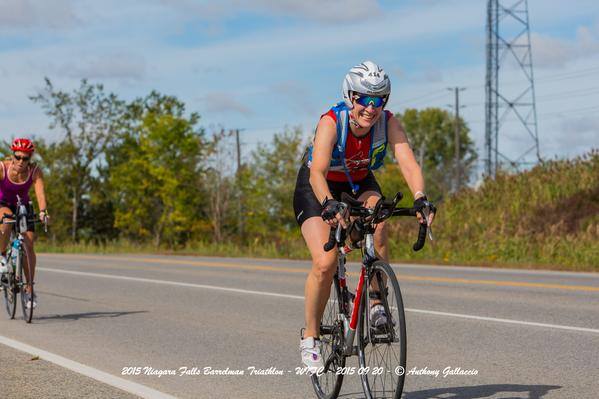
I left T1 riding along the recreational canal (you can just see the Welland International Flatwater Centre in the background) to the street. I might not be fast, but I looked it in my new Rudy Project helmet!


Out on the bike course, I realized that my technology jinx struck again because my watch wouldn't come out of swim mode, no matter how many times I pressed the mode and lap buttons. The thing was frozen...which meant all it would give me was total time. Seriously...I swear Garmin hates me. This is the second Barrelman in a row where I had watch-fail.

But, thanks to last year, I did have a backup plan. There were mile markers every 5k...and I knew 2min per km was 30km/h. So I was able to approximate my time at each of the mile markers to see if I was on track.

Opposite to last year, I got a light tailwind the first half of the course, which meant I averaged around 30km/h for the first hour or so. The second half of the course I got more of a headwind, but nothing like the craziness of last year. It's funny....afterwards I heard people complaining about the wind. Personally, it didn't bother me in the slightest. I just kept thinking how much nicer it was than last year!

I was able to eat and drink very well on the bike...even if my nose would run disgustingly every time I drank from my camelbak. Thank goodness for bike gloves - and finally being able to take my hands off my handlebars so I could wipe my nose without any problems. But still: yuck!

Got to the mid-way mark and saw a photographer.


Kilometres 65-80 were the worst for me - not because I was feeling bad, but because the roads seemed to be a lot crappier than they were last year. I know I slowed down in that section, but I did my best. Thankfully the last 10km or so was back along the Niagara Parkway, leading into Niagara Falls....perfect way to end a bike ride, since I got up my speed again.

Was very surprised to see my friend (and Limitless Coaching Coach) Eric D'Arcy with about 8km left to go. Eric had a bunch of his athletes racing so came out to spectate. I admit, seeing him gave me an added burst of energy!

I wasn't really sure what my bike time was when I pulled into transition, but I knew it was decently under my goal time of 3:15-3:18. Although the course was 3km shorter this year, so I wasn't sure how that would factor in. Turns out I was just a touch faster than my top end goal speed (28-28.5km/h) for the bike - with an average of 28.73 km/h. I was thrilled! That's almost 2.25km/h faster than I did last year!

Also - it makes me think that maybe, just maybe I'll be able to break 3 hours one of these days (or years) for a half ironman bike. What a crazy thought!

Bike time: 3:05:52 (10/21 AG - top half! Woohooo!)

T2

T2 was set up very similarly to last year, with a ton of volunteers making it easy to find my bike. One fabulous woman chatted with me as I was switching into my run gear - and offered to pack up all my bike stuff in the bag for me. Thanks awesome volunteer! :)

All this meant I had a decent T2 - again, taking a couple of minutes off compared to last year (2:53).

The Run

The run is by far the best part of Barrelman. It's also why one of these years I want to do the Niagara Falls International Marathon or Half Marathon (not sure what the race distance is). It's just such a gorgeous city.

Just out of T2, I saw my friend Kim (saw a ton of people I knew over the course of the day - it was fantastic!). I managed to smile, although I was in the process of trying to beat my watch into submission with the hope I could get it to work for the run. Miraculously I did!

The route for the run was changed a bit this year...which seemed to both add more hills (which it didn't - but the course certainly felt hillier than last year)...and some stairs (a few going up and then an entire flight going down) which we had to do on both laps. I walked down the stairs both times because I have a propensity for tripping down stairs and didn't want to do that in a race.

Just like last year, I loved, loved, loved running by the falls. I was even very lucky that no cars were going by when I was running by the photographer - since he captured an incredible  picture!


I actually felt pretty good on the run - better than last year - but I was actually a tad slower much to my surprise. Still had good pacing though. I was about 2min slower on the second lap, but that's mostly because I was a bit slower on the hills and the stairs I think - and I stopped a bit more at aid stations and made sure to test some coke (since I wanted to see how my stomach would react if I drank it at IMAZ).

Overall, this run was fantastic - and the aid station folks all the way along were amazing!

Run time: 1:58:44 (8/21 AG)

The finish

When I turned into the finisher's chute, I could see the clock and it read 5:47:xx - I was absolutely over the moon. Running toward the finish, I was practically flying I felt so good. All I had been hoping for was to break 6 hours, but I broke it by a ton. Even the 3km shorter bike course didn't account for all 26min I shaved off my time from last year.


Final thoughts

Really big thanks to Multisport Canada for putting on such a fabulous race - and to the absolutely amazing crew of volunteers. You guys all went above and beyond my expectations. Thanks for a great day!

Also, as always, a big shout out to my Coach Mark Linseman. He's patience personified when it comes to my biking efforts - but it's thanks to him I'm getting better and better every single day when it comes to triathlon. You're awesome Coach!

Next stop? Ironman Arizona.


Thursday, September 24, 2015

Spotlight on Hurdle Project Team Member: Pro Triathlete Jackson Laundry

Following up on my interview with Coach James Loaring about the LPC Hurdle Project…I wanted to showcase one of the talented Hurdle Project team members: Jackson Laundry.

2015 Hurdle Project Team. Photo Credit - Pixelate Image Professional Photography

Jackson is a rising force in the triathlon world, winning numerous races this summer across the province and the overall Multisport Canada Series. He’s got a great future ahead of him as a pro triathlete.

I actually conducted this interview early in the summer, but wanted to time it for after the introduction to the Hurdle Project. Alas, the summer went by way too quickly, so it's now it's a little bit of a retrospective interview. But it’s actually fascinating to see what Jackson’s goals were leading into the summer given how well he’s done since.

To find out more about Jackson and to follow his triathlon career, you can find him online at www.jacksonlaundry.com  and on twitter (@jacklaundry93).

Big thanks to Jackson for waiting so patiently for this interview to be posted – and for sharing such wonderful insights about his experience in triathlon and his participation in the Hurdle project. Can't wait to see what the future holds for this talented triathlete!

Now on with the interview!


Tell me a bit about your background - how did you get into triathlon

I got into the sport in 2004 (age 10) when I participated in the Belleville Kids of Steel Triathlon. In my age category I was last out of 64 in the swim portion! I was pretty disappointed at the time, but for the next 5 years or so I did the Picton Kids of Steel race each year, always without much training. Then in 2009 my dad and I “trained” (did about 4 weeks of training) for the Peterborough Sprint Triathlon. Ever since then I’ve slowly but surely increased my focus and seen improvements.
 
What's been your greatest accomplishment in triathlon and/or in life - so far?

My biggest accomplishment in triathlon has been winning 2 world age-group medals for the 2013 and 2014 sprint and Olympic distance triathlon championships.  After winning the bronze in Edmonton I felt I had accomplished everything I wanted to in the age-group division and was ready to move on to pro racing.

My greatest non-triathlon related accomplishment was graduating from the University of Guelph with a Bachelor’s degree in Human Kinetics with a Nutrition minor.  I am proud to say that I was able to balance full time schooling with training at a professional level.

You've already had a great start to this racing season with the overall win at Multisport Canada's Woodstock Triathlon. What are your big goals for 2015 (and beyond?)

This season I have 2 main goals, the first is to race well in some pro non drafting races (The New York City Triathlon and the Des Moines Triathlon). The second goal is to race well in draft legal races, which will give me a good chance for Quest for Gold funding. The races are is Magog, Ottawa, and Punta Guilarte. I guess I just mainly want to perform well in the “big” races with a competitive pro field.

How did you get involved in LPC and the Hurdle Project?

I have been a member of team LPC since well before the Hurdle Project was officially launched, so I was able to become part of it as it developed from the ground up. I earned my spot on the squad presumably by being dedicated to high performance, and by having pretty good success since joining team LPC.

How is being involved in the Hurdle Project helping you work toward and achieve your goals?

The Hurdle Project is immensely helpful in my triathlon career. It helps by covering a lot of training and racing costs, and providing very affordable but highly specific coaching. James Loaring puts a lot of time and effort into the Hurdle Project and gives the most effective coaching possible to the HP athletes.

You have some excellent fellow Hurdle Project Squad members. Do you find being part of a group makes a difference?

Being part of a group helps me mainly by making training more fun, which provides a lot more motivation to get the work done. We have a wide range of ability levels within our team, but James is able to modify workouts so everyone has a similar training plan, and can choose to do many workouts with team mates. There are also weekly workouts, like brick workouts, that all LPC athletes are welcome to attend.

Looking at the bigger picture, why do programs like the Hurdle Project matter for the sport of triathlon?

Support programs for athletes are very important for the development of elite athletes. The costs of triathlon (and other sports) can get very high, and athletes who want to improve need to train a lot. These are conflicting realities, because more training means less time to work, which makes it hard to pay for the sport. Support programs are necessary for making the sport more affordable, which will help developing athletes reach their goals.

Is there anything you'd like to say about being involved in the Hurdle Project that I wouldn't think to ask?

The Hurdle Project is a great way for a business to advertise for their company. If you visit the Hurdle Project Sponsorship Levels page on www.loaringpersonalcoaching.com you can see that there are many advertising opportunities that can be taken advantage of by any company that wants to support the program.
 
How can people follow your triathlon journey?

The best way to follow my triathlon endeavors is by visiting my blog/website at www.jacksonlaundry.com or following me on twitter (@jacklaundry93).
 
Wasaga Beach Triathlon (2015)
 
 
Big thanks again to Jackson for taking time out of his busy triathlon season to talk to me about his experiences with the Hurdle Project! Thanks Jackson!


Monday, September 14, 2015

Spotlight on the LPC Hurdle Project with Coach James Loaring

Over the past few months, I’ve been fascinated by a project the team at Loaring Personal Coaching (LPC) has been working on to help support developing and elite triathletes. I think the thing that I’ve been amazed by most is the true generosity of most of these young and incredibly talented triathletes. The ones I’ve met are positive, supportive and good role models for how I view the triathlon community.

Given the Hurdle Project is a new initiative this year, I asked Coach James Loaring if I could interview him regarding the project. I’ve also conducted a complementary interview with Jackson Laundry – one of the Hurdle Project team members and a very talented young athlete. Look for Jackson’s interview to be featured in my next blog!

So without further ado…my interview with Coach James Loaring!

2015 Hurdle Project Team. Photo Credit - Pixelate Image Professional Photography
 
Where did the idea for the Hurdle Project come from?

Funding and support opportunities are scarce for developing and elite triathletes and runners.  Providing good coaching is critical, but if it is not affordable then the athlete might eventually have to quit the sport years before they harvest their potential. Providing service/product/financial support is necessary to help keep their dream alive, to provide more long-term sustainability so that the athlete can continue to chase their athletic goals.

We (Coach Mark Linseman and I) are motivated to help develop a team of passionate and hard-working individuals. By creating a team, all individuals benefit and feed off of each other in a positive way.

It seems like LPC has always made an effort to give back to the community and to the sport. How does the Hurdle Project fit in with this mindset?

Since 1999, LPC/Loaring “grass-roots” events have raised over $200 000 for various charities. Since 2014, LPC events help to fund-raise for the Hurdle Project, with the vision that we are investing into “proactive healthcare” by directly supporting hard-working and talented athletes, and indirectly inspiring many more (of all ages and abilities) to lead a healthy and active lifestyle.

Our next LPC event is the WestMONSTERrun on Halloween in Guelph. Proceeds at this family-friendly community 5k costume run and kids MONSTER dash will go to the Hurdle Project.

How do you choose the athletes on the Hurdle Project squad? Can elites and/or future elites apply to become part of the project?

Hurdle Project athletes must fulfill one of the following minimum prerequisites:

·         Elite: current elite/pro triathlete or runner status in Canada or other country (any age)

·         Future Elite: under 24 years of age with the goal of competing in triathlon or running at the elite level

·         Ambassador: Under 30 years of age, working or studying part-time or full-time, and a member of teamLPC for at least one year.

If they fit one of the above criteria, the potential Hurdle Project athlete can apply by submitting this questionnaire:


When we receive an inquiry and/or questionnaire, we begin the process of determining if the athlete would be a good fit for the Hurdle Project. A positive team environment and culture is very important to us. We will not choose a potential applicant if we get the sense that they might often demonstrate a negative mind-set during group training. Our goal is to help develop athletes who tend to be mostly positive, supportive teammates, role models, community leaders, are relentlessly passionate, and feed off of a hard-working team culture.

What makes the Hurdle Project unique from other high performance training groups?

Provincial and National high performance groups often must focus the specificity of training and development for Draft-Legal racing, because funding for these groups are given to develop athletes toward events that are a part of the Olympic Program. The Hurdle Project is diversified and comprises athletes that are training for all different triathlon and running formats, from Junior Draft-Legal racing to Elite ITU racing, from non-drafting Sprint and Standard Distances to Ironman, from 800m on the track to the Marathon.

Few high performance groups are able to simultaneously provide all three of what we consider to be long-term key success factors: quality affordable high performance coaching, a positive team environment/culture, service/product/financial support to help make “chasing the dream” economically feasible and sustainable. We strive to achieve “coaching, culture, support” excellence.

 What is your long term vision for the Hurdle Project?

To hurdle from “good” to “great”. We aim to continuously evolve our systems so that the big three key success factors “coaching, culture, support” gradually progress from good to great. We have a lot of work to accomplish for us to achieve our long-term goals, and then build upon these goals toward bigger ones. 

I know you have several organizations sponsoring the Hurdle Project. Are you looking for additional sponsors?

We most definitely are looking to build long-term relationships with more companies who share our vision, and who would receive a good return on their investment.

We are fortunate to have many supporters, and hope to partner with several more over the next few months. We have developed a sponsorship level page that helps to articulate how we can benefit a potential sponsor: www.loaringpersonalcoaching.com/lpc-hurdle-project-sponsorship-levels.html

In 2015, our main sponsors have been Dundas Speed Shop, Powerwave Energy Solutions, Pixelate Image Professional Photography, Gulliver’s Lake Carefree RV Resort, and Electrocom Canada Inc.

What are the biggest highlights from Hurdle Project Athletes so far this year?"

There have been many individual achievements that we have celebrated as a team that have included numerous overall wins at triathlon and run events across Ontario. But I am most proud when the athletes are very supportive of each other while they commit themselves to the process of consistently training well over a long period of time.

Are there any other interesting facts about the Hurdle Project you would like mentioned? 

The name “Hurdle” is a tribute to Johnny Wilfrid Loaring, my Grandfather, an Olympian Hurdler, Hall of Famer, and War Hero. JWL is symbolized in the LPC and Loaring Physiotherapy logos, which both feature a hurdler overcoming obstacles throughout the journey of achieving his/her personal goals.

The Hurdle Project Team currently comprises 13 athletes, who are all wonderful individuals both on and off the field of play.
 
Hurdle Project Team having fun. Photo Credit - Pixelate Image Professional Photography

A big thanks to Coach James for sharing his insights and vision for the Hurdle Project! No doubt there are great things to come from the Hurdle Project! For more information, visit the Hurdle Project Team page.